The four steps that close three walls
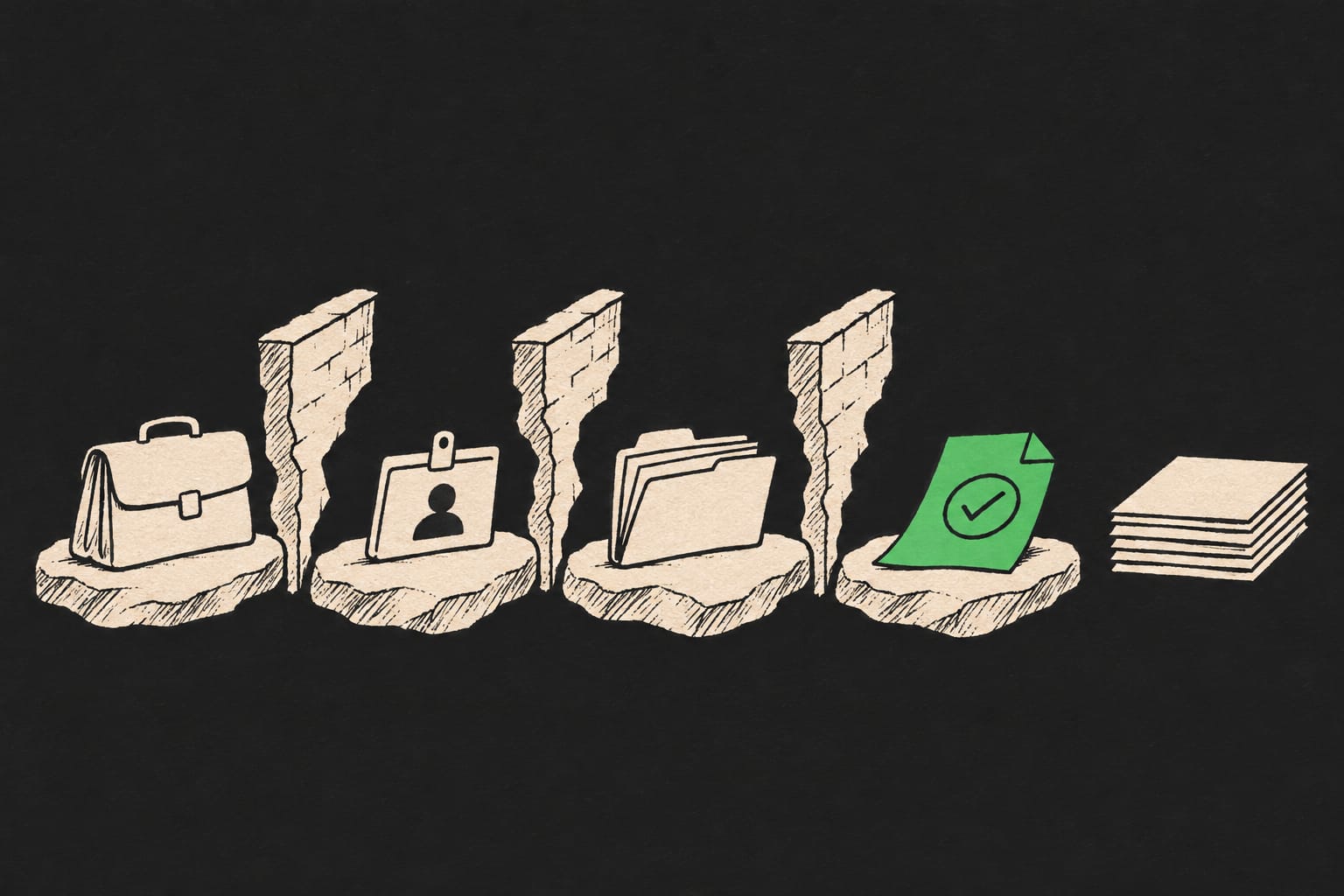
In much of the day-to-day AI coding work I see, people open an agent, type a prompt, copy or accept the diff, and move on. Every ticket gets a fresh habit made up on the spot. If you use a coding agent a few times a week, that loop feels fast until an agent marks half-done work complete, writes over open files, or gives a neat summary for broken code.
Earlier in this series, The Inversion of AI Tooling mapped my stack, and Three walls every multi-agent setup hits traced the commits where multi-agent runs hit three walls: ownership, persistence, and acceptance. Article 2 gave three practices usable with nothing installed, required sign-off from someone outside the build based on an artifact they read, and noted its practices had no set order. It closed by previewing four moves in order: scope the work, assign it, execute in its workspace, and verify against proof before marking done. Where Agents Need Architecture, Not Prompts argued for code locks, this habit needs no code.
Picking up Article 2’s preview, those four moves (Scope, Assign, Execute, Verify) form one chain when each step states its input, its handoff (the written output the next step reads), and the wall it closes. After I archived UACP, a heavier protocol I built, those plain-Markdown handoffs and the outside check stayed, while the enforcement code went. Later, drift in my private agent led me to write those rules into thirteen Markdown files with zero new code. They set rules for the orchestrator (the agent coordinating the work) and the route (the path setting how much review a change gets). An independent reviewer on a different vendor’s model read that Markdown and caught a transition-table row letting the orchestrator confirm its own route, so the agent coordinating the work could approve its own choice of how much review the change received.
These four steps run in sequence. Step 1 writes the fence Step 3 works inside and the test Step 4 checks.
Scope sets the boundary and how done is judged
Before you prompt an agent, set a rough timebox of a few minutes. My suggested start in Step 1 is one short paragraph of at most two sentences: state what is in scope, what is out, and the check that proves the task is done.
In The Last Six Months Before AI Compounding Hardens, the Delegator sets acceptance rules up front before an agent runs. Step 1 turns that habit into Step 4’s input. Waiting until a diff is on screen lets the agent’s output shape its own test.
Scope closes no wall alone. Article 2 showed that a file list in a brief does not block a stray edit mid-run; someone still has to read the diff. In my sessions, people skip the out-of-scope line most often, yet a boundary like “edit auth.ts; leave session tables and CI untouched” [illustrative] is easy to check in git diff.
Assign separates record ownership from the build
Take a couple of minutes before the build starts to pick the one role that may update the protected record. That choice closes Article 2’s ownership wall. A protected record is the file, task list, or mainline branch that counts as truth for finished work. Only the record owner updates it, and solely after Step 4 passes. Whether you run three agents or one shell beside TODO.md, the builder edits files and reports back, and the owner marks completion or merges. A written convention alone does not stop a skip, so make that write path real: reserve merge rights to the owner, or keep the task record outside the builder’s writable workspace. In my judgement, setting that write path up front solves most of Wall 1.
Second, choose which agent runtime and model will edit the files in Step 3, matched to the task. In my preference, simple coding goes to faster, cheaper models and architecture or design goes to deeper-reasoning models so spend tracks difficulty. Choose the reviewer at Step 4, so one actor does not pick the builder and its checker together.
Execute isolates the workspace and saves the proof
Run the builder in a separate checkout or git worktree by default, stay inside Step 1’s fence, and save proof to a lasting home before teardown. Both halves of Article 2’s persistence wall sit in Step 3.
The first half isolates live writes. Switching Git branches inside one shared folder leaves one working tree on disk. If two sessions write there at once, files collide. Giving each task its own folder with git worktree add keeps live edits off the main tree. If the builder finds it must touch an excluded file, stop the run and update Scope first so the diff never widens in silence.
Save the diff and test output before deleting the workspace. Keep that proof readable until Step 4 finishes. Before you delete a worktree, folder, or chat session, copy all needed proof into a durable destination that outlives teardown, such as commits or the pull request record.
Verify checks from outside and names what is unknown
Step 4 is non-negotiable. An actor outside the build reads the diff against Step 1, runs checks in a clean shell, and marks pass, fail, or unknown before the protected record changes. This closes Wall 3, acceptance.
Article 2 settled the standing separation rule (“the one who writes is not the one who reads”) and showed why self-sign-off fails without dishonesty: the actor that built the work stands inside it. Article 2 listed pass, warn, or fail, leaving missing proof open. Leaving warn untouched, Step 4 uses pass, fail, and unknown (“couldn’t tell”, or met, unmet, and unavailable in Nora).
Each required check is a gate: a stop where work waits until an outside actor reads proof and marks pass. An unknown mark never passes a required gate, so no actor waves an unchecked item through. Diffs and behaviour are proof, never the builder’s claim, story, or exit code alone. Check the real claim, since a proxy test proves solely the proxy, and write unknown when you cannot tell.
Scaling the check without dropping the rule
These four steps are my lightweight default, with review depth scaled to the stakes. For a two-line fix, write one scope sentence and use a worktree. The agent writes the change, and you read every hunk of its diff in a clean shell and run a local check. If you wrote or edited any of the change, someone outside it must do the check: another person, or a reviewing agent that did not write it. A migration may need the full weight. Two rules never shrink away: unknown never counts as pass, and the builder never signs off its own work. In my judgement, a small habit keeping those two rules beats a big system missing either one.
Once the work is checked, when the workflow asked for heavier proof than the decision needed, write one standalone lesson line naming the process fix beside the change.
Thirteen Markdown files and a self-confirming table
I ran this text-only setup on Nora, my private standalone agent. A soft lifecycle had let three orchestrator sessions drift on one unbounded brief, so I replaced soft advice with step gates across thirteen Markdown files, using my archived protocol solely as a design reference.
Step 1 opened with a five-part brief: Intent, Done when, Boundaries, References, and Current state. A Done-when list is a fixed set of yes-or-no items naming the proof a reviewer checks. Once I approved it as operator (I, as the human who approves and merges), it locked. The builder never marks items met, the reviewer marks each met, unmet, or unavailable, the operator alone may amend the list, and outside findings become follow-ups.
Each Done-when item named its proof. One item required a transition table listing each handoff’s input, checker, pass or block proof, and escalation rule. A second set route cutoffs: ≤2 files for direct and >6 items for split. Other items added a brief-and-plan gate before large builds, an execution receipt linking each item to proof, re-triage rules when work widens, and line budgets keeping skill files short. Because this brief predated the six-item cap and receipt rule it added for future standard and full work, its pull request record held the brief, diffs, marks, lesson note, and merge commit.
Boundaries made “zero enforcement code” easy to check. In scope were thirteen Markdown files: four skills (work, dispatch, review, land), five references, and four support docs (agent rules, orchestration, review, and style). Out of scope were new scripts, hooks, or CI jobs, edits to existing hooks or CI, and six old protocol parts left behind at archive time.
In Step 2, roles split up front. As operator, I kept sole rights over the protected record: locking or amending Done-when before build, and merging to mainline after review passed. Nora’s orchestrator logged the route. One builder edited the files on Claude Code CLI, the terminal runtime for Claude models (on paid plans; I use Claude Ultra, formerly Max 20x, at $200/mo). At Step 4, an independent reviewer ran on another vendor’s model.
In Step 3, those thirteen Markdown files changed on the pull request branch, with zero scripts, hooks, CI jobs, or tests touched. That branch kept edits off mainline, and the pull request and review records held the proof before merge. This walkthrough does not evidence worktree isolation.
Mid-build, I amended escalation so Nora asks the operator solely for intent (Done-when changes), authority (merge, deploy, paid runs, live accounts, or side effects past the brief), or a redesign when a review closes no blocking issues. That rule clashed with the draft re-triage list, which sent every new area to the operator. A follow-up edit fixed the list: a new area re-routes to the next brief review, while new Done-when items, missing authority, out-of-brief side effects, or stalled reviews go to the operator.
In Step 4, the independent reviewer read the diff against Done-when, marked a running CI check unavailable, and caught two bugs in the gate rules.
First, the top row of the transition table let the orchestrator confirm its own route, so the coordinating agent could pick direct and skip brief and plan checks. The fix split recording from confirmation. Now the orchestrator records the route and never confirms its own route; the route’s first independent reviewer checks it against triggers and flags under-routing.
Second, the review row asked for an execution receipt and per-item marks on every route, though light and direct never make them before merge. Lighter work could stall on a missing file, risking a bypass. The fix split inputs by route: standard and full need the reviewed brief and plan, operator sign-off, and receipt; light needs a brief in the pull request body; and direct needs pull request review and CI.
Later, a separate follow-up commit (not caught in that review) fixed a third bug in the work skill. Its check asked every next action’s input to carry sign-off from someone outside its maker. On light, no reviewer reads the brief until final review, so that check failed before build. The follow-up commit narrowed the work check to run solely where the route assigns a checker before the next action. In my reading, all three bugs came from rules about independence written by the actor under them.
Right before merge, one Done-when item stayed open. It was meant to establish that full CI held on the merge, and the reviewer had marked it unavailable. The operator owns the locked list, so my waiver amended the list. It did not turn unavailable into pass. The record shows a waiver plus a focused check of 122 passes beside one doc-budget failure already red on mainline; it does not show a passing full run, and the merge check was not clean. This is the standalone lesson line in action: the item demanded heavier proof than the decision needed, and the waiver and a proposed edit to the brief template’s evidence rule (preferring the cheapest check that decides an item) are recorded.
Why I archived the protocol and kept the Markdown
Before Nora’s skills, I built UACP, a governance protocol for agent work, and archived it. Archived here means I chose to stop work and close the project. The repo stays public and is not marked archived on GitHub.
UACP ran work through six phases in a fixed order. Routing sent tasks to direct, lightweight, standard, full_governance, or block_or_clarify, scaling proof by domain, risk, reversibility, and file type. Proposals stated authority up front. Policy and step checks were designed to guard calls and handoffs, while an intent contract (a target set in planning, proved in build, and judged in review) checked whether build matched plan.
I archived UACP for three reasons, each my own judgement about my workflow:
- Keeping up enforcement code (scripts, config files, and score rules) cost more care than it paid back, even with lighter routes.
- I built much of its enforcement layer to compensate for what earlier models could not yet be trusted to do, and in my judgement that code stopped being worth maintaining.
- In my judgement, newer models plus the coding agent’s harness (worktrees, branches, diffs, test runs, and separate review chats) now cover much of what I built UACP to enforce in my work.
In my reading, after an optional brainstorm entry stage, triage sets Scope’s boundary, propose sets Scope’s done check and Assign’s authority, plan maps Assign’s work units, execute maps to Step 3, verify maps to Step 4, and resolve closes out the lifecycle. UACP never claimed that match. Saving proof before teardown comes from Article 2 and the pull request record, while merge rights and lesson lines come from Nora.
While one habit for forming judgements (comprehend, measure, serialize, or CMS) went into Nora’s architecture, the lifecycle habits moved into those thirteen Markdown files as text:
| Habit | What UACP did | What Nora’s Markdown does |
|---|---|---|
| Step order | Ran tasks through six phases in a fixed order | Lists those six phases in a fixed order in work’s reference |
| Sizing review | Sent tasks to direct, lightweight, standard, full_governance, or block_or_clarify | Logs direct (≤2 files), light, standard, full, split (>6 items), or clarify |
| No self-sign-off | Used code checks designed to guard calls and handoffs | Names an outside checker per row; orchestrator never confirms its route |
| Authority | Stated allowed actions and side effects in a proposal | Puts Intent and Boundaries in the brief; locks Done-when after operator sign-off |
| Plan vs build | Set a target in planning, proved it in build, and judged the match | Uses a receipt on standard and full; builder never marks items met |
| Ceiling | Intended runtime code as the ceiling | Uses text stops; review or merge is meant to refuse work if a skipped step leaves a required file missing |
Those Markdown files state their limit plainly. Skills are text an agent reads, so Nora’s gates do not stop skips and do not catch every skip. A helpful agent halts at them, while an agent can still pick a low route or edit before plan sign-off. The stated backstop is conditional: when a skipped gate leaves a required file for that route missing, the reviewer at review or the operator at merge is supposed to refuse the work, and the first independent reviewer checks whether the route was too low.
Try the four lines on one task this week
Pick one coding task this week and write four lines in a note, issue, or pull request draft before you prompt an agent:
- Scope: in, out, and the done check.
- Assign: who edits and which runtime, and who alone updates the protected record or merges.
- Execute: an isolated checkout or worktree, with the diff, test output, and verdict saved to commits or the pull request record before cleanup.
- Verify: an independent check that is never the builder, with the reviewer picked here and
unknownnever counting as a pass.
Carry those four lines through an isolated run and an outside check. You need no protocol repo, skill files, CI pipeline, or set CLI. Where Nora’s direct route (≤2 files, no behaviour change, no heavy-route trigger) still asks for pull request review and CI, a tiny solo fix shrinks further: the agent writes the change, and you read every hunk of its diff in a clean shell and run a local check. If you wrote or edited any of the change, someone outside it must do the check: another person, or a reviewing agent that did not write it.
Further reading
- The Inversion of AI Tooling: From Access to Architecture: Article 1 on my agent stack.
- Three walls every multi-agent setup hits: Article 2 on the three walls and the four-move preview.
- Agents Need Architecture, Not Prompts: when text rules give way to code locks.
- The Last Six Months Before AI Compounding Hardens: setting upfront acceptance criteria as a Delegator.
- UACP on GitHub: the public repo for the archived protocol (
mikeng-io/uacp). - COGNITION.md: public notes on explicit
unknownmarks, proxy checks, and scaling review depth.